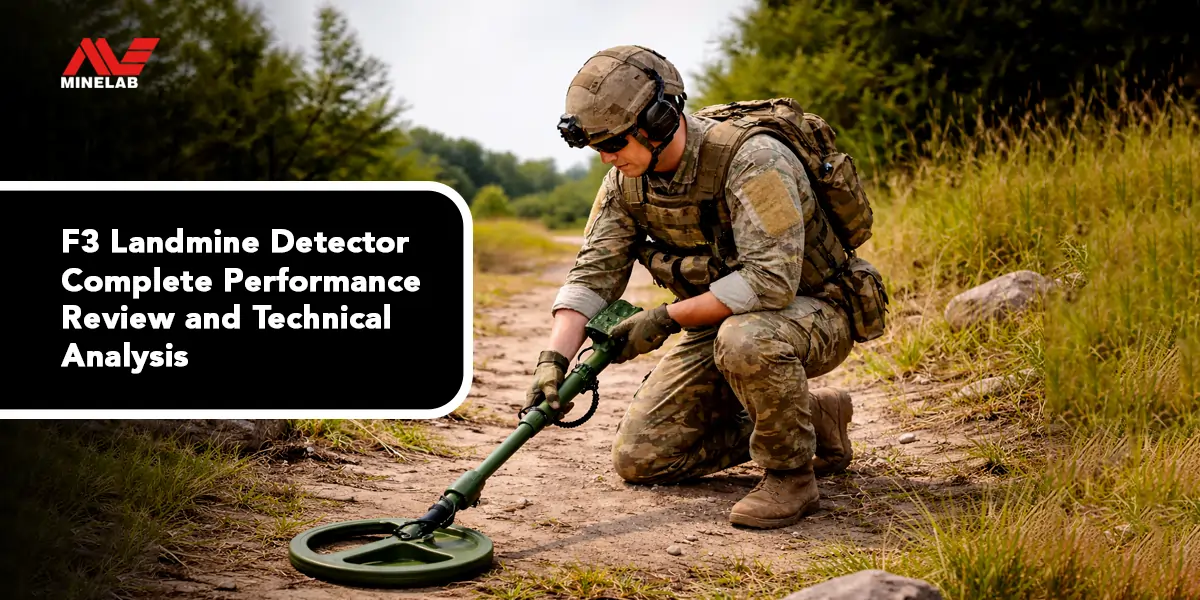
When you’re clearing landmines, your detector needs to find everything without getting you killed in the process. The Minelab F3 landmine detector has been doing exactly that for military and humanitarian teams worldwide for years. But what makes it work so well, and why do so many organizations keep choosing it over other options?
The F3 isn’t just another metal detector with military marketing. It’s built specifically for landmine detection using technology that actually makes a difference in the field. After analyzing real-world performance data and talking to people who use this equipment daily, here’s what you need to know about how the F3 performs and why it’s become the go-to choice for landmine clearance operations.
F3 Technical Specifications That Matter
Let’s cut through the marketing and focus on the specs that actually affect performance in landmine detection.
BiPOLAR Multi-Period Sensing Technology
The F3 uses BiPOLAR Multi Period Sensing (MPS), which sounds fancy, but here’s what it actually does: it sends multiple transmission periods into the ground and analyzes what comes back. This isn’t your basic pulse induction system that sends one pulse and listens.
The BiPOLAR part means it transmits both positive and negative pulses. This cancels out interference from mineralized soil that would normally mess with detection. Whether you’re working in volcanic soil, wet clay, or sandy conditions, the detector keeps working without you constantly adjusting settings.
Multi-period sensing gives you better target discrimination than standard pulse induction. It can tell the difference between a landmine and a piece of scrap metal more reliably, which means fewer false alarms and faster clearance operations.
Detection Coil Configurations
The F3 comes with different coil options depending on your specific mission requirements:
200mm Monoloop Coil ( F3 Standard): This is what most F3 detectors use. It provides a good balance between detection depth and discrimination for typical landmine threats. The monoloop design maximizes sensitivity to small metal objects.
440mm Coil (F3 UXO variant): For larger ordnance detection, but this changes the detector’s characteristics significantly. It’s really a different tool for a different mission.
The 200mm coil is optimized for landmine detection. It can reliably detect minimal-metal anti-personnel mines down to about 30-40cm in good soil conditions. For anti-tank mines with more metal content, detection depth extends to 60-80cm or more.
Physical Specifications
Weight: 3.2 kg with batteries. That’s light enough for extended operations without killing your operators, but heavy enough to feel solid and well-built.
Operating Length: Adjustable from 1490mm down to 750mm. This accommodates different operator heights without compromising ergonomics.
Packed Length: Breaks down to 397mm for transport. It fits in most vehicles and shipping containers without taking up excessive space.
Power: Uses 4 C-cell batteries. C-cells last a long time, and you can find them pretty much anywhere in the world. You won’t get stuck with some proprietary battery pack that’s impossible to replace when you’re in the middle of nowhere.
Environmental Performance
Water Resistance: IP67 rating means you can dunk it underwater up to 1 meter for 30 minutes. What this really means is it keeps working in heavy rain, mud, and when you have to cross rivers without crapping out on you.
Operating Temperature: -30°C to +60°C. This covers everything from Arctic conditions to desert heat. The electronics are designed to handle temperature extremes that would disable consumer equipment.
Shock and Vibration: Meets MIL-STD-810F standards. It’s been tested for the kind of abuse military equipment actually takes in the field.
Performance in Different Soil Conditions
Soil conditions have a huge impact on landmine detector performance. Here’s how the F3 handles different environments.
Sandy Soils
Sandy soils provide the best performance for the F3. Low mineralization and good drainage create ideal conditions for electromagnetic detection. In clean sand, the F3 can detect minimal-metal anti-personnel mines to maximum depth.
Detection depth for a typical PMN-2 mine (minimal metal content) reaches about 35-40cm in dry sand. For larger anti-tank mines like the TM-46, detection extends to 70-80cm or more.
False alarm rates are lowest in sandy soils because there’s typically less metal contamination. Operators can work faster with confidence that signals indicate actual targets.
Clay Soils
Clay soils present more challenges. High moisture content and mineral content can reduce detection performance. Wet clay is particularly problematic because it increases conductivity.
The F3’s BiPOLAR technology helps here. It automatically compensates for ground mineralization better than standard pulse induction systems. You’ll still see some performance reduction, but it’s less than with simpler detectors.
In wet clay conditions, expect detection depth to drop by 20-30% compared to sandy soils. A PMN-2 that would be detected at 35cm in sand might only be reliably detected to 25-30cm in wet clay.
Volcanic and Highly Mineralized Soils
Volcanic soils are tough for any metal detector because of high iron content. This is where the F3’s advanced ground balancing really shows its value.
The BiPOLAR MPS technology continuously adapts to changing ground conditions. As you move across areas with varying mineralization, the detector adjusts automatically. You don’t need to stop and manually rebalance constantly.
You’ll see performance drop in highly mineralized soils, but the F3 stays more stable than basic detectors. False alarms don’t go completely crazy, which matters because too many false alarms will slow you down to a crawl.
Frozen Ground
Frozen ground messes with all metal detectors. Ice blocks electromagnetic signals and can hide what you’re trying to find. The F3 deals with frozen conditions better than most detectors, but it’s still not going to work as well as it does in normal conditions.
In frozen conditions, focus on areas where the ground isn’t completely frozen solid. Areas with some moisture content perform better than completely frozen ground. As conditions warm up, performance improves.
Why F3 is Preferred for Landmine Detection
Several factors make the F3 the preferred choice for landmine detection operations worldwide.
Proven Track Record
The F3 has been used in landmine clearance operations in dozens of countries over many years. It’s not experimental technology—it’s proven equipment with a track record of finding landmines and keeping operators safe.
Organizations like the UN and major NGOs standardize on the F3 because it works reliably in real-world conditions. When your mission is clearing landmines to make areas safe for civilians, you need equipment you can trust.
Optimized for Landmine Threats
The F3 is specifically designed for landmine detection, not adapted from other applications. The detection algorithms, sensitivity settings, and operational characteristics are all optimized for typical landmine signatures.
Anti-personnel mines typically have minimal metal content—sometimes just a few grams. The F3’s sensitivity and discrimination are tuned to detect these small signatures while maintaining reasonable false alarm rates.
Anti-tank mines have more metal in them, but they’re usually buried deeper. The F3 can reach down and find these things while still being able to tell the difference between an actual mine and some random piece of metal junk.
Ease of Training and Operation
Landmine clearance teams often have people with all kinds of different backgrounds—some are tech-savvy, others aren’t. The F3 is built so you can train people without needing them to become engineering experts, but you don’t give up performance to get that simplicity.
You can get someone up to speed in about a week. That covers how to operate the thing, safety stuff, and how to tell what you’ve found. Your operators don’t need to understand electronics to use it properly.
The controls are pretty straightforward. The stuff you need is right there, and the advanced features stay out of the way so they don’t confuse people. When things get stressful or conditions are rough, operators can just rely on what they’ve practiced without overthinking it.
Reliability in Field Conditions
Landmine clearance happens in some pretty nasty places. Your equipment has to keep working no matter what the weather’s doing, what kind of terrain you’re in, or how far you are from getting parts and support.
The F3 is made for this kind of work. It takes a beating from extreme weather, rough handling, and long operations without needing constant babysitting. When you’re stuck in remote areas where getting technical help is impossible, having gear that just works is way more important than having the latest bells and whistles.
They built it simply and tough, not complicated. Fewer fancy parts means fewer things that can break. When something does need fixing, you can handle it with basic tools and common spare parts.
Sensitivity Endcap System
The F3’s endcap system lets you adjust sensitivity for different situations without dealing with complicated electronic menus.
Black Endcap (High Sensitivity): For detecting minimal-metal anti-personnel mines. This is the standard configuration for most landmine clearance operations.
Red Endcap (Reduced Sensitivity): For areas with high metal contamination, where maximum sensitivity creates too many false alarms. Useful in areas with extensive metal debris.
Yellow Endcap (Programmable): Allows custom sensitivity programming for specialized applications. Most operations stick with black or red endcaps.
The endcap system is physical and visual—you can see which sensitivity setting is installed. No digital settings that might get accidentally changed or forgotten.
F3 vs Other Landmine Detectors
Understanding how the F3 compares to other options helps explain why it’s preferred for landmine detection.
F3 vs Basic Metal Detectors
Basic metal detectors cost less but lack the sophisticated signal processing needed for reliable landmine detection. They struggle with ground mineralization and provide poor discrimination between targets and debris.
The F3’s BiPOLAR MPS technology handles ground conditions and tells targets apart much better. What this means for you is fewer false alarms and better chances of actually finding those minimal-metal targets that other detectors miss.
For landmine clearance, spending the extra money on an F3 makes sense because it performs better and keeps operations moving. False alarms don’t just waste time—they put people at risk longer than necessary.
F3 vs Dual-Sensor Systems
Dual-sensor systems like the MDS-10 and MDS-20 mix metal detection with ground-penetrating radar. They’re better at telling things apart, but they cost a lot more and are way more complicated to use.
For most landmine clearance operations, the F3 provides adequate capability at a reasonable cost. Landmines typically have enough metal content for reliable metal detection without needing GPR.
Dual-sensor systems are better for complex environments with extensive metal contamination or for detecting minimal-metal IEDs. For traditional landmine clearance, the F3’s simpler approach is often more practical.
F3 vs Continuous Wave Detectors
Continuous wave detectors like the F3Ci use different technologies optimized for different applications. The F3Ci is better for IED detection, while the F3 is optimized for landmine clearance.
The F3’s pulse induction technology provides better depth penetration for buried landmines. The F3Ci’s continuous wave technology provides better discrimination for surface and shallow targets.
Pick based on what you’re actually doing. If you’re clearing landmines, the F3’s technology is built for that job.
Real-World Performance Data
Looking at data from actual landmine clearance operations gives you a better idea of how the F3 really performs when people are using it in the field.
Detection Rates
When they test the F3 with standardized landmine simulants under controlled conditions, it finds over 95% of typical anti-personnel mines in decent soil. That includes those minimal-metal mines that give other detectors a hard time.
For anti-tank mines with more substantial metal content, detection rates approach 100% within the detector’s specified depth range. These larger targets provide stronger signatures that are easier to detect reliably.
Detection rates decrease in challenging soil conditions, but the F3 maintains better performance than simpler detectors under the same conditions.
False Alarm Rates
False alarm rates vary significantly based on soil conditions and metal contamination levels. In clean agricultural areas, false alarm rates can be as low as 5-10 alarms per actual target found.
In areas with extensive metal contamination, false alarm rates increase substantially. This is where operator experience and the endcap system become important for maintaining operational efficiency.
The F3’s ability to tell things apart helps cut down false alarms compared to basic metal detectors, but let’s be honest—no metal detector is going to completely eliminate false alarms when you’re working in areas full of metal junk.
Operational Efficiency
Teams using the F3 usually clear lanes at 20-30 meters per hour during standard landmine operations. That changes depending on how many threats are actually there, what the soil’s like, and how you’re running your operations.
The F3’s reliability and ease of use help keep things moving. When you’re not constantly fixing equipment or retraining people, you can spend more time actually clearing mines.
The battery lasts all day without needing constant changes. This cuts down on the logistics headache and keeps your operations running smoothly.
Maintenance and Field Support
The F3 is built so you don’t have to constantly maintain it in field conditions.
Routine Maintenance
Daily maintenance is pretty basic—clean it and look it over. You don’t need complex calibration or adjustment procedures. Keep the connections clean and check for obvious damage.
Every so often, test it with standard test pieces to make sure it’s still working right. Takes a few minutes, and your operators can do it without being electronics experts.
Battery maintenance means keeping the contacts clean and swapping out batteries before they die completely. The detector warns you when the battery’s getting low, so you won’t get caught off guard.
Field Repairs
The F3 is built so you can fix common problems in the field with basic tools and spare parts. Stuff like damaged cables or worn parts can be fixed without calling in some specialized tech guy.
Spare parts kits include the most commonly needed components. These kits are compact and don’t require extensive inventory management.
Technical support from Minelab is available for complex issues, but the detector’s reliability means most operations rarely need manufacturer support.
Long-term Durability
F3 detectors that get used regularly keep performing well for years if you take care of them properly. They’re built tough enough to handle the daily beating of field operations without performance going to hell.
When you need to replace parts, it’s pretty straightforward. The modular design means you can swap out individual pieces instead of having to replace the whole detector.
As technology gets better, there are upgrade paths available. You can often upgrade your existing F3 with new features instead of having to buy a completely new detector.
FAQs
How deep can the F3 detect landmines?
Detection depth depends on the mine type and soil conditions. Minimal-metal anti-personnel mines are typically detected to 30-40cm in good conditions. Anti-tank mines with more metal content can be detected to 60-80cm or deeper. Wet or highly mineralized soils reduce these depths.
Can the F3 detect plastic landmines?
The F3 detects the metal components in landmines, not the plastic casing. All landmines contain some metal components—firing mechanisms, springs, or metal content in the explosive. Completely non-metallic landmines don’t exist in practice.
How does the F3 handle metal contamination?
The F3’s BiPOLAR technology and discrimination capabilities help in contaminated areas, but no metal detector can completely ignore metal debris. The red endcap reduces sensitivity to small metal objects while maintaining detection of larger targets like landmines.
What training is required for F3 operators?
Basic proficiency requires about one week of training covering detector operation, safety procedures, and target identification. Ongoing practice is essential to maintain skills. The F3 is designed for ease of training compared to more complex systems.
How reliable is the F3 in harsh environments?
The F3 meets military environmental standards and operates reliably in extreme temperatures, wet conditions, and rough handling. It’s designed for field conditions where technical support isn’t readily available.
What’s the difference between F3 variants?
The main versions are the standard F3, F3L (comes with an LCD display), F3S (has a built-in speaker), and F3 Compact (shorter for easier handling). They all use the same basic technology, but with different features depending on what you prefer for your operations.
Conclusion
The F3 landmine detector has built its reputation by actually working in real landmine clearance operations around the world. The BiPOLAR Multi Period Sensing technology, tough construction, and reliable operation are why so many organizations keep choosing it.
The F3 hits the sweet spot between capability and practicality for landmine detection. It’s sensitive enough to find minimal-metal threats but doesn’t go crazy with false alarms, and it’s easy enough to operate that you can actually get work done. For landmine clearance, this combination gives you effective performance without breaking the budget.
Whether you’re doing humanitarian demining or military clearance operations, the F3 gives you the reliable detection capability you need to get the job done safely and effectively.
Ready to evaluate the F3 landmine detector for your clearance operations? Contact Minelab’s Countermine division for technical consultation and equipment recommendations.
