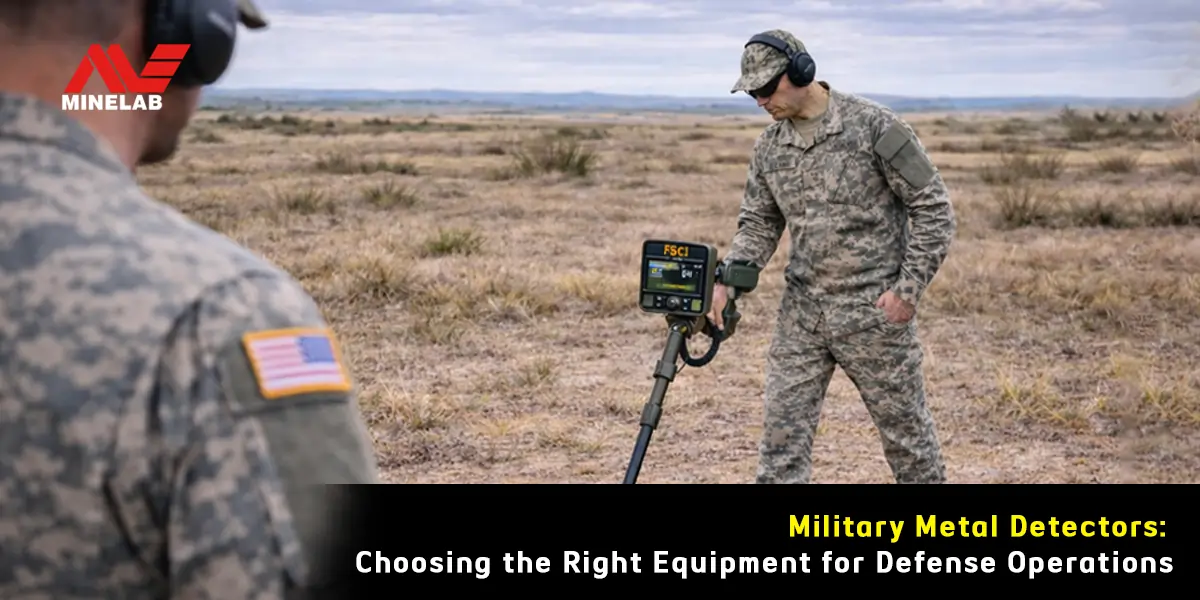
Military Metal Detectors: Choosing the Right Equipment for Defense Operations
Here’s the thing about military metal detectors—when your life depends on finding a threat before it goes off, you’re not just picking another tool. You’re choosing equipment that works better when it counts.
Defense forces around the world deal with threats that keep changing. IEDs buried in roads. Landmines from conflicts that ended decades ago. Unexploded ordnance. Weapons stashed in buildings. Getting the right countermining equipment means you need to understand what you’re actually facing, where you’re working, and what your people can realistically use when things get rough.
Military vs Civilian Detection Requirements
Let’s be clear—there’s a huge difference between civilian metal detecting and what military forces need. It’s not even close.
Someone looking for coins in a park? They need a detector that goes down a few inches and makes noise when it hits something. That’s perfectly fine for what they’re doing.
Military metal detectors are a different animal entirely. You’re detecting landmines, IEDs, UXO, and weapons in places nobody wants to be—combat zones, extreme weather, contaminated ground.
Here’s what a military metal detector actually has to do: find minimum-metal mines buried in soil that messes with most detectors, keep working after getting dropped off a truck or hit with blast overpressure, operate when it’s -30°C or +60°C (or worse), survive getting soaked in rivers, covered in mud, or sandblasted, and give you results you can trust no matter what kind of soil you’re in.
Military-grade countermine equipment gets tested to standards like MIL-STD-810G. Civilian detectors? They’re not even designed for this kind of punishment.
NGO vs Military Requirements
Humanitarian demining organizations use similar technology, but they’re playing a different game. NGOs care a lot about cost-effectiveness and getting equipment that lasts for years because they’re clearing land for communities over the long haul.
Military operations work differently. Mission success and keeping your people alive come first. Speed matters because routes need clearing before convoys roll. And military budgets usually let you buy premium equipment when the mission actually needs it.
Most military operators doing this work are career EOD specialists. They can handle complex equipment because they’ve trained for it. Training time exists. Technical support runs through military logistics chains.
Key Requirements for Military Metal Detectors
Durability and Environmental Resistance
Military operations happen in conditions you wouldn’t wish on your worst enemy. Equipment gets dropped. Thrown into vehicles. Exposed to blasts nearby. Soaked in rivers. Caked in mud. Baked in desert heat that makes you question your life choices.
Look for MIL-STD-810G or MIL-STD-810H compliance. These standards mean the equipment got tested against drop shock, vibration, crazy temperatures, humidity, salt spray, and everything else that can go wrong.
IP68 waterproofing isn’t optional. An IED detector that stops working when it gets wet is worse than carrying nothing—at least then you know you don’t have protection. IP68 means it can go underwater to 3 meters. River crossings, monsoons, whatever nature throws at it.
Operating temperature needs to cover at least -30°C to +60°C. You might be working in Arctic cold or desert heat that could fry an egg on the hood of your vehicle.
Operational Versatility
Military forces run into all kinds of threats. A mine detector that only works well on anti-personnel mines won’t help when you hit an area full of UXO. A bomb locator designed for big metal targets might completely miss minimum-metal IEDs.
The best military metal detectors can handle:
- Anti-personnel mines that barely have any metal in them.
- Anti-tank mines.
- Unexploded artillery shells and bombs.
- IED components, including command wires that are almost invisible.
- Weapons caches.
- Booby traps set by people who know what they’re doing.
Tactical Features
Sometimes your tactical situation doesn’t allow for a detector beeping away. Silent operations need silent detection.
Multi-alert systems give you real options:
- Audio alerts through an earset when you’re doing normal operations.
- Visual LED display when it’s too noisy to hear anything.
- Vibration alerts when you absolutely need to stay silent.
You should be able to turn off whatever alert doesn’t fit your current situation.
Compact and lightweight design actually matters more than people think. Soldiers are already hauling heavy loads. A detector that packs down small and weighs under 3 kg makes a real difference when you’re out there for hours or days.
Night vision compatibility helps when you’re working after dark.
Detection Capability
Pulse Induction technology gets good depth and handles mineralized soils well. The F3 series uses Multi-Period Sensing, which is basically an advanced version of Pulse Induction.
Continuous Wave technology gives you excellent sensitivity to small metal pieces and can tell ferrous from non-ferrous metals. The F3Ci uses VFLEX Continuous Wave technology—works great as an IED detector.
Multi-frequency technology runs multiple frequencies at the same time, which improves how well you detect different targets. The MF5 does Simultaneous Multi-Frequency Digital.
Ground Penetrating Radar combined with metal detection gives you comprehensive capability against minimal-metal threats. The MDS-10 and MDS-20 are dual-sensor systems that put both technologies together.
Types of Military Detection Operations
Route Clearance
Before your convoy moves, somebody’s got to clear the route. Route clearance teams sweep roads and paths for buried IEDs and landmines. This work happens under pressure—the convoy’s waiting, time matters, but you absolutely cannot rush and miss something.
Route clearance often happens in open terrain with soil that changes as you go. A military metal detector for this job needs:
- Good depth penetration.
- Reliable performance no matter what soil you’re in.
- Durability to handle all-day use, day after day.
Base Security and Perimeter Defense
When you’re setting up a forward operating base, you clear the area first. That’s not negotiable. Perimeter security means regular sweeps checking for infiltration attempts—buried weapons, explosives, whatever someone might try.
This work is thorough and methodical. You’re not racing the clock. A UXO detector with good discrimination helps you tell actual threats from all the random metal junk that piles up around old military sites.
EOD Operations
EOD teams respond when threats are reported. Could be investigating a suspected IED. Clearing a building after a firefight. Searching for secondary devices after an attack. Dealing with UXO somebody just stumbled across.
EOD operations need versatile equipment because the threat type changes. A compact, lightweight bomb locator that handles multiple scenarios fits what EOD teams actually do.
Counter-IED Operations
Counter-IED missions specifically go after improvised explosive devices. These threats often use minimal metal—plastic containers, thin command wires, and carbon rod pressure plates instead of metal ones.
Detecting minimal-metal IEDs is tough for standard metal detectors. Advanced technology like dual-sensor systems that combine metal detection with GPR works better for these threats.
The F3Ci ied detector has discrimination capability, which really helps when you’re working in urban areas full of metal clutter. You can tell IED components from harmless junk.
Building and Structure Clearance
Urban operations mean searching buildings for hidden weapons, explosives, or IEDs. You’re working in tight spaces.
The F3Ci’s compact design (packed length is only 397mm) works well for building clearance. The discrimination capability helps in urban environments because buildings are full of harmless metal—rebar in concrete, pipes, electrical wiring, all kinds of stuff.
Minelab Military Metal Detectors
F3 Series: Proven Military Workhorse
The F3 landmine detector series has been proving itself in military operations worldwide for years now. It uses BiPOLAR Multi Period Sensing technology—basically an advanced pulse induction system.
Key features for military use:
- Detects all metal and minimum metal mines effectively
- Works reliably, no matter what kind of soil you’re dealing with
- Built rugged enough to survive getting beaten up in the field
- Water-resistant to 3 meters (IP67 rating)
- The technology is simple and proven, so you’re not spending months training people.
- You can adjust sensitivity by swapping out endcaps.
F3 configurations: The standard F3 gives you audio alerts—straightforward and reliable. The F3L adds an LED display for visual alerts. The F3S lets you adjust sensitivity in the field. The F3LS combines both the LED display and sensitivity adjustment. The F3 UXO uses a bigger 450mm coil that gets you more depth when you’re clearing UXO.
The F3 series suits military forces that need reliable, proven mine detection capability. It’s the workhorse detector—not the fanciest tech out there, but it works consistently, and that’s what matters.
F3 Compact: Lightweight Tactical Detector
The F3 Compact gives you F3 performance in a smaller, lighter package. At 2.7 kg and 405mm packed length, it’s noticeably more portable.
Military applications:
- Patrol operations where soldiers carry the detector along with everything else for immediate threat response
- Airborne and air assault operations where every kilogram you’re carrying matters
- Vehicle-mounted quick reaction forces
- Special operations that need to keep gear minimal
F3Ci: Enhanced IED Detector
The F3Ci is specifically designed for IED and ERW detection. It uses Continuous Wave VFLEX technology instead of pulse induction.
Key features:
- Discrimination capability that tells ferrous from non-ferrous metals
- Multi-alert system covering audio, visual LED, and vibration
- Compact design (397mm packed length, 2.6 kg)
- Three detection modes: Detection, Interrogation, Pinpoint
- Waterproof to IP68 standard (3 meters)
The F3Ci’s discrimination helps a lot when you’re in urban environments or anywhere with metal clutter. The multi-alert system supports different tactical situations—turn off the LEDs when you need light discipline, use vibration alerts for silent ops, and use audio through an earset for normal operations.
As a bomb locator, the F3Ci excels at picking up the metal components that give away concealed explosive devices.
MF5: Multi-Frequency Versatility
The MF5 runs Simultaneous Multi-Frequency Digital technology. It operates at four frequencies between 5 kHz and 75 kHz all at once.
Military advantages:
- Detects metal and conductive targets, including fine wires and carbon rods that other detectors miss
- Works effectively across all soil types
- Improved performance in mineralized soils that give other detectors headaches
- Can identify whether targets are ferrous, non-ferrous, or carbon rod
The MF5 suits military forces operating across varied environments. If your missions take you from desert to jungle to urban areas, the multi-frequency capability adapts to whatever you encounter.
For counter-IED operations where threats might include fine command wires or carbon-rod components, multi-frequency MF5 provides detection capability where standard detectors don’t perform well.
MDS-10 and MDS-20: Advanced Dual-Sensor Systems
The MDS series puts metal detection and Ground Penetrating Radar together. This dual-sensor approach gives you comprehensive detection capability that standard detectors just can’t match.
Key features:
- Detection of low-metal and minimum-metal threats that other detectors miss.
- User interface that’s actually intuitive, with a real-time display showing what you’re seeing.
- Built tough to MIL-STD-810H standards.
- Waterproof to IP68 (can handle submersion to 3 meters).
- Battery life over 7 hours.
The MDS series represents premium countermine technology. You’d consider these systems when you’re facing sophisticated minimal-metal threats, operating where standard metal detection isn’t cutting it, or when mission requirements actually justify the higher investment.
One thing about GPR, though—it works best in dry, low-conductivity soils. In wet or highly conductive soils, GPR effectiveness drops off. The metal detection component still works fine, but you’re not getting the full dual-sensor benefit.
Choosing Equipment for Military Missions
General Infantry and Combat Units
Infantry units need reliable, straightforward equipment that soldiers can learn to use without months of specialized training.
Recommended: F3 Compact or standard F3 series. You get proven reliability, simple operation, and rugged construction. The F3 Compact’s lighter weight helps when soldiers are carrying it alongside all their other combat gear.
EOD Teams
EOD specialists deal with all kinds of threats, and they’ve got the training to handle sophisticated systems.
Recommended: F3Ci is solid for urban and IED-focused operations. MDS-10 or MDS-20 when you need that comprehensive detection capability. F3 UXO for environments where there’s a lot of ordnance. Most EOD teams actually keep multiple detector types around because different scenarios call for different tools.
Counter-IED Units
Counter-IED teams deal with nasty stuff—minimal-metal IEDs, command-wire devices, improvised threats that are hard to detect.
What works: F3Ci when you need to separate actual threats from all the junk in cluttered areas. MDS series for those minimal-metal threats. MF5 when you’re hunting for fine wires or carbon rods.
Special Operations Forces
SOF units want compact, lightweight gear that packs small and gets into action fast. Tactical features actually matter for these operations.
Recommended: F3 Compact when you need minimal weight and bulk. F3Ci when you want tactical features and versatility.
Technical Specifications That Matter
When you’re looking at a military metal detector, there are certain specs that actually tell you whether this thing will work when your life depends on it.
Environmental Ratings: Look for MIL-STD-810G or 810H compliance—that means somebody actually put it through hell during testing instead of just claiming it’s rugged. You want IP67 or IP68 waterproofing (IP68 is better because it can handle being dunked deeper). Temperature range should cover at least -30°C to +60°C, though you’ll probably end up working in conditions that are even worse.
Physical Specifications: Weight under 3 kg so you can carry it all day without dying. Packed length under 500mm makes it easier to transport and store in vehicles. Adjustable operating length is important so tall and short operators can both use it without throwing out their backs.
Detection Specifications: Coil size needs to balance depth with maneuverability. Detection depth should be adequate for whatever threats you’re targeting. Adjustable sensitivity helps when conditions change.
Power and Battery Life: Common battery types are easier to get through your logistics chains. Battery life of 8-10 hours gets you through a full operational day. Quick battery changes matter when operations go longer than planned.
Procurement Considerations
Military procurement needs detailed specifications. You have to define what capabilities you actually require, what environmental ratings you need, performance standards, training and support requirements, and documentation needs.
Think about what it’ll actually cost you over time, not just what the price tag says. You’ve got to factor in training costs, spare parts and maintenance, batteries and consumables, technical support, and how long the thing will actually last. Sometimes you’re better off spending more upfront on a detector that lasts longer and requires less maintenance—it ends up costing less in the long run.
Standardization makes your life way easier. When everyone’s using the same gear, training is simpler, getting spare parts isn’t a nightmare, and tech support actually knows what they’re talking about.
Equipment Comparison
F3 Series vs F3Ci
Choose F3 when: You need solid, reliable mine detection that works everywhere, keeping things simple matters, or you’re mostly dealing with regular mine threats.
Choose F3Ci when: Finding IEDs is your main job, you need better discrimination in your area, tactical features matter for your missions, or you’re working in cities a lot.
Standard Detectors vs Dual-Sensor Systems
When dual-sensor makes sense: You know you’re dealing with minimal-metal mine threats, sophisticated IEDs, soil conditions that work well with GPR (dry soils), and you’ve got the budget for premium gear.
When standard metal detection works fine: Regular mine and UXO threats, wet or conductive soils where GPR sucks, tighter budgets, or you just prefer proven technology that works.
Here’s the reality—many military operations succeed just fine with standard metal detection. The MDS series gives you additional capability when threats and conditions actually warrant it.
Conclusion
Look, picking the right military metal detector isn’t rocket science—you just need to match what the equipment can do with what your missions actually demand. The F3 series has proven itself reliable for conventional threats. The F3Ci brings tactical features and discrimination that work well for IED operations. The MDS series gives you advanced dual-sensor capability when you’re dealing with sophisticated threats.
At the end of the day, choose equipment that actually fits what you need operationally, works reliably in whatever conditions you’re operating in, and meshes with your existing logistics and training setup.
Need guidance on military metal detector selection? Contact Minelab’s Countermine division for consultation on military detection equipment.
Common Questions
What’s the best military metal detector?
There isn’t one “best” detector—it really depends on your mission, what threats you’re facing, and your specific requirements. The F3 series is the proven workhorse. The F3Ci excels for IED operations. The MDS series provides advanced capability for sophisticated threats.
How long does a military metal detector last?
With proper maintenance, quality military detectors last 5-10 years or longer. Minelab equipment is built for long operational life.
Can one detector handle all military missions?
Versatile detectors like the F3Ci or MF5 handle varied missions pretty well. But specialized missions benefit from specialized equipment. Many military units keep multiple detector types on hand.
What training is required?
Basic proficiency takes 2-3 weeks. Advanced proficiency for complex systems takes longer. You need ongoing training to maintain skills—they degrade if you don’t practice.
Are expensive detectors worth it for military use?
Depends entirely on the mission. If you’re facing minimal-metal IEDs and standard detectors aren’t working, advanced systems are absolutely worth the investment. Match the capability to what you actually need.
