F3 UXO Detector: Technical Specifications and Operational Guide
When you’re clearing former battle zones of unexploded ordnance, your detection equipment needs to perform under the worst conditions imaginable. This isn’t recreational metal detecting—you’re hunting for live artillery shells, bombs, and rockets buried at depths that would challenge most standard equipment. One missed target could mean casualties when civilians return to reclaim their land.
The F3 UXO detector was built specifically for this kind of work. It’s engineered differently because UXO detection is a completely different challenge than mine clearance—you’re looking for bigger targets buried deeper and scattered randomly across former battle areas.
What Makes the F3 UXO Different from Regular Detectors
The F3 UXO uses the same BiPOLAR Multi Period Sensing technology you’ll find in other F3 detectors, but that’s where the similarities end. This detector is configured specifically for hunting unexploded ordnance.
BiPOLAR Multi-Period Sensing: How It Actually Works
This isn’t your basic pulse induction system. The F3 UXO sends multiple transmission pulses into the ground and analyzes what comes back. Unlike simpler systems that send one pulse and listen, Multi-Period Sensing gives you better target discrimination and can punch deeper into the ground.
The BiPOLAR part means it transmits both positive and negative pulses. Why does this matter? Because it cancels out the effects of mineralized soil that would normally mess with your detection. Whether you’re working in volcanic soil, wet clay, or sandy conditions, the detector keeps working without you having to constantly fiddle with settings.
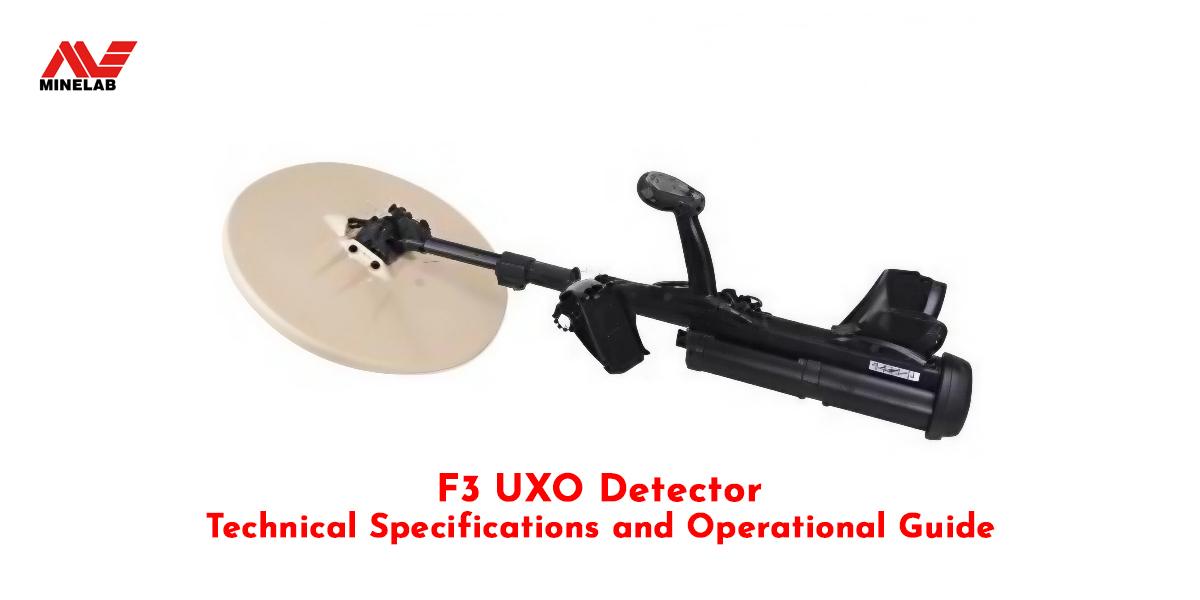
The 450mm Coil: Why Size Matters
Here’s the big difference—literally. The F3 UXO uses a 450mm search coil instead of the 200mm coil you’d find on a standard mine detector. That’s almost twice the size, and it’s not just for show.
A standard mine detector with a 200mm coil might detect a large artillery shell down to maybe 60-80cm. The F3 UXO’s 450mm coil can find that same shell at 1-1.5 meters deep in good conditions. When you’re dealing with bombs that punched deep into the ground on impact, that extra depth capability can be the difference between finding a threat and missing it completely.
Why Regular Mine Detectors Don’t Work for UXO
Mine detectors are built to find small targets at shallow depths. They’re optimized for minimal-metal content—sometimes just a few grams of metal. The F3 UXO is designed for targets with serious metal content—we’re talking kilograms, not grams.
The way you actually operate these detectors is completely different, too. With mine detection, you’re crawling along with slow, careful sweeps and tight lane spacing because you’re looking for tiny targets. UXO detection? You can move faster and use wider lanes since you’re hunting for much bigger targets that throw stronger signals.
Technical Specs That Actually Matter
Let’s break down what the F3 UXO can actually do, not just marketing fluff.
Detection Performance Numbers
Search Coil: 440mm monoloop coil designed for maximum depth penetration. The monoloop design prioritizes depth over discrimination—exactly what you need for UXO work.
Detection Depth: This depends on what you’re looking for and what kind of soil you’re in. For a 155mm artillery shell, you’re looking at roughly 1 meter detection in average soil. Bigger targets like bombs can be detected deeper. Smaller stuff like mortars might only be detectable to 60-80cm.
Technology: Pulse Induction with BiPOLAR Multi-Period Sensing. This handles all soil types without you having to manually adjust ground balance settings.
Environmental Toughness
Water Resistance: IP67 rating means it can be submerged to 1 meter for 30 minutes. In real terms, it handles river crossings, heavy rain, and muddy conditions without dying on you.
Operating Temperature: Works from -30°C to +60°C. That covers everything from Arctic conditions to desert heat that could fry an egg on your vehicle’s hood.
Military Standards: Meets MIL-STD-810F environmental standards. It’s been tested for drop shock, vibration, temperature cycling, and humidity exposure—the kind of abuse military equipment actually takes.
Physical Characteristics
Weight: 4.1 kg (9 lbs) with batteries installed. Yes, it’s heavier than mine detectors, but that’s the trade-off for the larger coil and deeper detection capability.
Operating Length: Adjustable from 1620 mm to 7620 mm. This accommodates different operator heights and working positions without killing your back.
Power and Battery Setup
Battery Type: Runs on 4 D-cell batteries—either alkaline or rechargeable NiMH. D-cells give you long operational life, and you can find them anywhere in the world.
Battery Life: Gets you through a full operational day on one set of batteries under normal conditions. Cold weather kills battery life faster, so pack spares for extended operations.
How the Endcap System Works
The F3 UXO uses Minelab’s endcap system for adjusting sensitivity. It’s a physical system that’s simple, reliable, and works well in field conditions.
Black Endcap: High Sensitivity
The black endcap gives you high sensitivity for detecting a wide range of UXO sizes. This is what comes standard and what you’ll use for most clearance operations.
When to use it: General area clearance, looking for varied ordnance types and sizes, working in areas where you don’t know what contamination to expect, or when you need maximum detection capability.
Red Endcap: Reduced Sensitivity
The red endcap reduces sensitivity, focusing on large targets only. This is useful when you’re specifically hunting for bombs and large artillery shells, or when you want to ignore smaller metal debris.
When to use it: Initial surveys to identify major threats, areas with high levels of metal contamination where high sensitivity generates too many false alarms, or when you’re specifically searching for large ordnance while ignoring smaller items.
Changing Endcaps in the Field
Swapping endcaps is straightforward. Power down the detector, unscrew the current endcap, install the new one, power back up, and wait 12 seconds for automatic ground balancing.
The endcap system is physical and visual—you can see which sensitivity setting is installed. No digital menus or settings that might get accidentally changed. Just physical components that work reliably.
Where the F3 UXO Actually Gets Used
Agricultural Land Clearance
Farm areas often have UXO mixed with farming debris—metal fence posts, machinery parts, and irrigation equipment. The F3 UXO’s discrimination isn’t sophisticated enough to automatically separate these, so operator experience really matters here.
In agricultural soil, which is usually well-drained and low in mineralization, the F3 UXO reaches maximum detection depth. A 155mm artillery shell might be detectable to 1.2-1.5 meters under good conditions.
You can use wider lane spacing for UXO work—75-100cm lanes are typical versus 50cm for mine detection. The larger coil and bigger targets let you cover ground faster while still catching everything important.
Urban UXO Detection
Urban environments are complicated. Destroyed buildings are full of rebar, pipes, electrical wiring, and structural metal that sets off the detector constantly.
The F3 UXO will detect all this metal, but experienced operators learn to tell the difference between ordnance signals and building debris. Ordnance usually gives clean, strong signals. Building debris often produces irregular or multiple overlapping signals that sound different.
What Detection Depth Can You Expect
Large bombs (500+ pounds): Detectable to 2+ meters in good conditions. These create strong, unmistakable signals that you can’t miss.
Artillery shells (105-155mm): Typically detected to 1-1.5 meters depending on soil conditions and how the shell is oriented underground.
Mortars (60-120mm): You’re usually looking at 60-100cm detection depth. The smaller mortars are pushing the limits of what the F3 UXO can reliably pick up.
Rockets and missiles: This one’s all over the place, depending on how big they are and how much metal they’ve got in them. The bigger rockets behave pretty much like artillery shells.
Grenades: These are often right at the edge of what the F3 UXO can detect. If you’re working in an area that’s mostly small ordnance like this, you’d probably be better off with standard F3 detectors.
F3 UXO vs Other Detection Options
Picking the right detector comes down to what you’re actually trying to accomplish and what kind of threats you expect to find.
F3 UXO vs Standard F3
Go with the F3 UXO when: You’re dealing with large ordnance, need to detect stuff buried deep, are doing battle area clearance, or you know for sure there’s UXO contamination in the area.
Stick with the standard F3 when: Most of your threats are smaller items like grenades or mortars, you need something lighter and more portable, you’re doing both mine and UXO clearance, or your budget is tight, and you need the cheaper option.
The standard F3 with its 200mm coil weighs 3.2 kg versus 4.1 kg for the F3 UXO. For extended operations where operators carry the detector around, this weight difference matters more than you’d think.
Detection depth differs significantly. The standard F3 might detect a 155mm shell to 60-80cm. The F3 UXO detects the same target to 1+ meters. That’s a substantial difference when you’re looking for deeply buried ordnance.
F3 UXO vs Dual-Sensor Systems
Choose F3 UXO when: You’re dealing with conventional UXO with adequate metal content, cost-effectiveness is important, simplicity and reliability are priorities, or soil conditions don’t support effective GPR.
Choose dual-sensor (MDS-10/MDS-20) when: You’re dealing with minimal-metal ordnance, working in urban areas with complex metal signatures, need GPR to distinguish targets from debris, or your budget allows for premium technology.
The MDS systems cost significantly more than the F3 UXO. For most UXO clearance, the additional GPR capability isn’t necessary—conventional ordnance has enough metal content for reliable metal detection.
Training and Getting Your People Ready
Good UXO detection isn’t just about having the right equipment—it’s about having people who actually know how to use it properly. The best detector in the world is useless if your operators don’t know what they’re doing.
What Your Operators Actually Need to Learn
Basic operation: Plan on 1-2 weeks to cover detector theory, controls, ground balancing, noise cancellation, and basic sweep techniques. This is the foundation—everyone needs to nail this stuff before they touch anything else.
Target identification: Additional time learning to distinguish ordnance signals from debris based on signal characteristics. This comes with experience and supervised practice in the field.
Safety procedures: Critical training on UXO hazards, safe approach techniques, investigation procedures, and marking/reporting protocols. This can literally save lives.
The F3 UXO is easier to learn than dual-sensor systems, but it still requires more training than your basic metal detectors because of all the UXO-specific features and safety protocols you have to follow.
Maintenance and Field Support
Routine maintenance: Keep the thing clean, check your connections, and keep an eye on battery condition. The F3 UXO doesn’t need much routine maintenance, which is great when you’re working in the field.
Spare parts: Stock up on the critical stuff—batteries, earsets, endcaps, basic tools. The detector is built so you can fix common problems in the field without needing a specialized tech guy to fly out.
Technical support: Minelab will help you out with operational issues when they come up. Set up your support channels before you deploy so you’re not scrambling to find someone when things go sideways.
Calibration: You don’t need to calibrate this thing routinely, but it’s smart to check it with test pieces every now and then to make sure it’s still working as it should.
How to Actually Use the F3 UXO
Using proper procedures gets the most out of your detector and keeps everyone safe.
Getting Started: Setup and Ground Balancing
Initial setup: Turn on the detector and hold it at whatever height you’ll be operating. Give it 12 seconds for the automatic ground balance to settle in. Don’t try to rush this part—just let the detector figure things out.
Noise cancellation: When you’re getting electromagnetic interference, use the noise-cancel function. This takes about 45 seconds and finds clean operating channels. Use this near power lines, communications equipment, or in urban areas with electrical interference.
What to Do When You Get a Signal
Signal marking: When you get a signal, mark the location immediately. Don’t rely on memory when you’re investigating multiple targets in an area.
Signal assessment: Strong, clear signals usually mean you’ve found something big. Multiple overlapping signals? That could be clustered ordnance from impact areas where several items landed on top of each other.
Investigation approach: Take your time approaching. Don’t assume any buried metal is harmless—that’s a good way to get yourself killed. UXO can be incredibly sensitive to disturbance, especially the stuff that partially went off but didn’t fully detonate.
Safety: The Most Important Part
Never move UXO: Mark it, record it, report it to EOD personnel. Disposal is for trained specialists only. Don’t try to be a hero.
Maintain safe distances: When investigating signals, approach carefully if you expose ordnance, back away, and establish appropriate safety cordons based on the item’s size and type.
Team operations: Never work alone. UXO detection should always be conducted with backup personnel who can summon help if something goes wrong.
Key Questions Answered
How deep can this thing actually detect?
Detection depth depends on what you’re looking for and what kind of soil you’re working in. A 155mm artillery shell might be detected to 1-1.5 meters in good conditions. Larger bombs can be detected deeper. Smaller mortars typically detect to 60-80cm. Wet or highly mineralized soils reduce these depths significantly.
How does it handle areas full of metal junk?
The detector’s going to find all metal, including junk. That’s just what metal detectors do—they detect metal. Experienced operators learn to tell the difference between ordnance signals and scrap metal based on how the signals sound and behave. The red endcap can help here by cutting down sensitivity to smaller debris while still catching the big targets you actually care about.
What’s the training time for new operators?
Basic proficiency requires 2-3 weeks, including detector operation, safety procedures, and supervised field practice. UXO-specific training covers threat recognition, investigation procedures, and safety protocols. Ongoing practice is essential to maintain competency—these skills degrade if you don’t use them.
How often does it need maintenance?
The F3 UXO doesn’t require routine calibration or complex maintenance. Basic upkeep involves keeping it clean and checking connections. Periodic verification with test pieces confirms it’s working properly. The detector is designed for minimal maintenance requirements in field conditions.
Conclusion: Is the F3 UXO Right for Your Mission?
The F3 UXO detector does exactly what it was designed for—detecting large ordnance at depth in former battle zones. Its 450mm coil, BiPOLAR Multi Period Sensing technology, and rugged construction make it the right tool for UXO clearance operations where standard mine detectors fall short.
Whether you’re working in recently liberated areas, clearing decades-old contamination, or conducting battle area clearance anywhere in the world, the F3 UXO provides reliable detection capability specifically engineered for this mission.
The detector isn’t fancy or overly complex—it’s straightforward, proven, and effective. For UXO clearance programs that need reliable detection equipment at a reasonable cost, the F3 UXO delivers exactly what’s required without unnecessary bells and whistles.
The key is matching your equipment to your actual mission requirements. If you’re dealing with large ordnance that needs to be detected at depth, the F3 UXO is built for that job.
Ready to evaluate F3 UXO detection equipment for your clearance program? Contact Minelab’s Countermine division for technical consultation and operational guidance.
